Curriculum

The Academy's curriculum is organized into tracks that can be combined, revisited, and extended. Each track emphasizes process over prediction and understanding over memorization.

Core tracks

Tracks are designed so that a motivated student can follow the material independently or as part of a guided cohort. Exercises focus on reasoning, documentation, and code you can come back to later.

Track 1 — Probability & Markets

Foundations · Approx. 6–8 weeks

  • Uncertainty, randomness, and simple betting games
  • Distributions commonly seen in markets
  • Expectation, variance, and correlation in practice
  • Law of large numbers and simulations
  • Common pitfalls in interpreting backtests
Track 2 — Data, Code & Microstructure

Data handling · Approx. 6–8 weeks

  • From CSVs to time series: cleaning and aligning data
  • Basics of order books, trades, and market venues
  • Simple event studies and intraday patterns
  • Dealing with missing, stale, or suspicious data
  • Documentation and reproducible notebooks

Track 3 — Systematic Thinking

Frameworks · Approx. 8 weeks

  • Idea generation without story-driven bias
  • From narrative to testable hypothesis
  • Factor thinking and simple cross-sectional signals
  • Regime awareness and robustness checks
  • Designing experiments you can falsify

Track 4 — AI Tools for Research

Tooling · Approx. 6 weeks

  • Where language models help (and where they don't)
  • Summarizing filings, news, and documentation
  • Simple embeddings for idea clustering and search
  • Guardrails, hallucinations, and verification
  • Integrating AI tools into existing research workflows

Learning in loops, not straight lines.

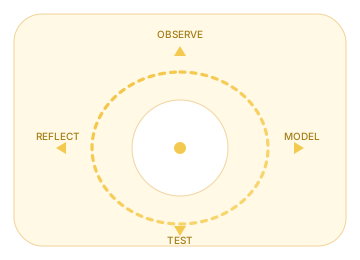
The curriculum is structured as a loop: observe data, propose a model, test it, reflect, and revise. Students are encouraged to keep a research journal, including dead ends and abandoned ideas.

Some modules draw inspiration from projects and tools used within ABX Capital Partners Asset Management, but all examples are presented at an abstract, educational level with simplified data.

Illustration of the learning loop

Who the curriculum is designed for

The Academy is not a test-prep service or a recruiting funnel. It is best suited to people who already care about markets and want a more rigorous, honest way to think about them.

Students

With an interest in math, CS, or economics who want to see how those tools show up in practice.

Career switchers

Engineers, analysts, or founders looking to deepen their understanding of market structure and risk.

Curious practitioners

People already working near markets who want a more structured way to learn and teach others.